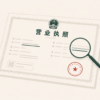
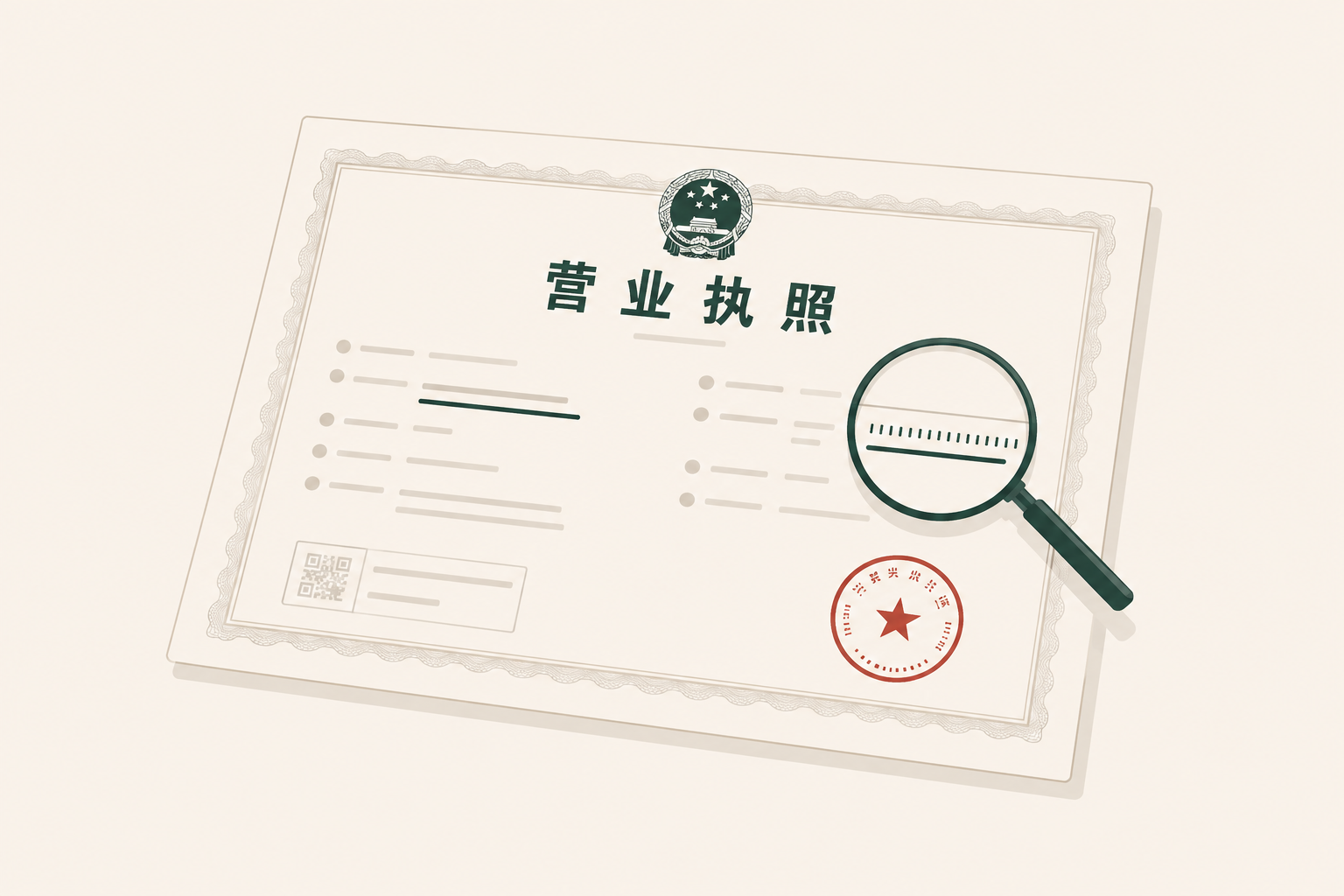
Every legitimate company in mainland China has a business licence — the 营业执照. Ask any serious supplier for a photo of theirs and they’ll send it, because it’s the document that proves they exist. The trick is knowing how to read it, because the licence carries everything you need to verify them.
There are five fields that matter.
Company name (名称): This is the full registered legal name, in Chinese. It is almost never the same as the brand or the shop name you saw on Alibaba. This is the name that must match their bank account.
Unified Social Credit Code (统一社会信用代码): An 18-character code — digits and capital letters. This is the company’s unique fingerprint, like a registration number. It’s the single most useful thing on the licence, because you can check it.
Legal representative (法定代表人): The person legally responsible for the company. Worth noting: a small trader might show 投资人 (investor) or 经营者 (operator) instead — that’s normal for sole proprietorships, not a red flag.
Registered capital (注册资本): How much the company was capitalised with. A company claiming to run a large factory but registered with tiny capital is worth a second look. Note the currency — foreign-invested firms are often in US dollars, not yuan.
Establishment date (成立日期): How old the company is. A supplier registered three weeks ago asking for a large deposit deserves caution.
Now, the checking part. That 18-character code isn’t random — it has a built-in checksum, a mathematical rule that the last character must satisfy based on the first seventeen. A real code always passes this check. A fabricated one, invented to make a fake licence look legitimate, almost always fails it.
This is the quiet power of the code: a scammer can photoshop a convincing-looking licence, but they usually can’t produce a code that passes the checksum and matches a real registered company. That’s why the very first thing Sauri Check does with any licence is validate that code — before spending money on any deeper look. A clear, sharp licence photo whose code fails the checksum is one of the strongest fraud signals there is.
You can’t run the checksum in your head. But you can insist on seeing the licence, read these five fields, and be suspicious if a supplier is reluctant to share it. Reluctance is itself information.